yes


Across history, humanity has encountered the unknown many times. Each time, faith has not been weakened by new knowledge — it has been refined by it. If elements of the UAP mystery someday prove to reveal intelligence beyond our own, such a discovery would not erase God — it would simply remind us that creation may be far larger than our current understanding.
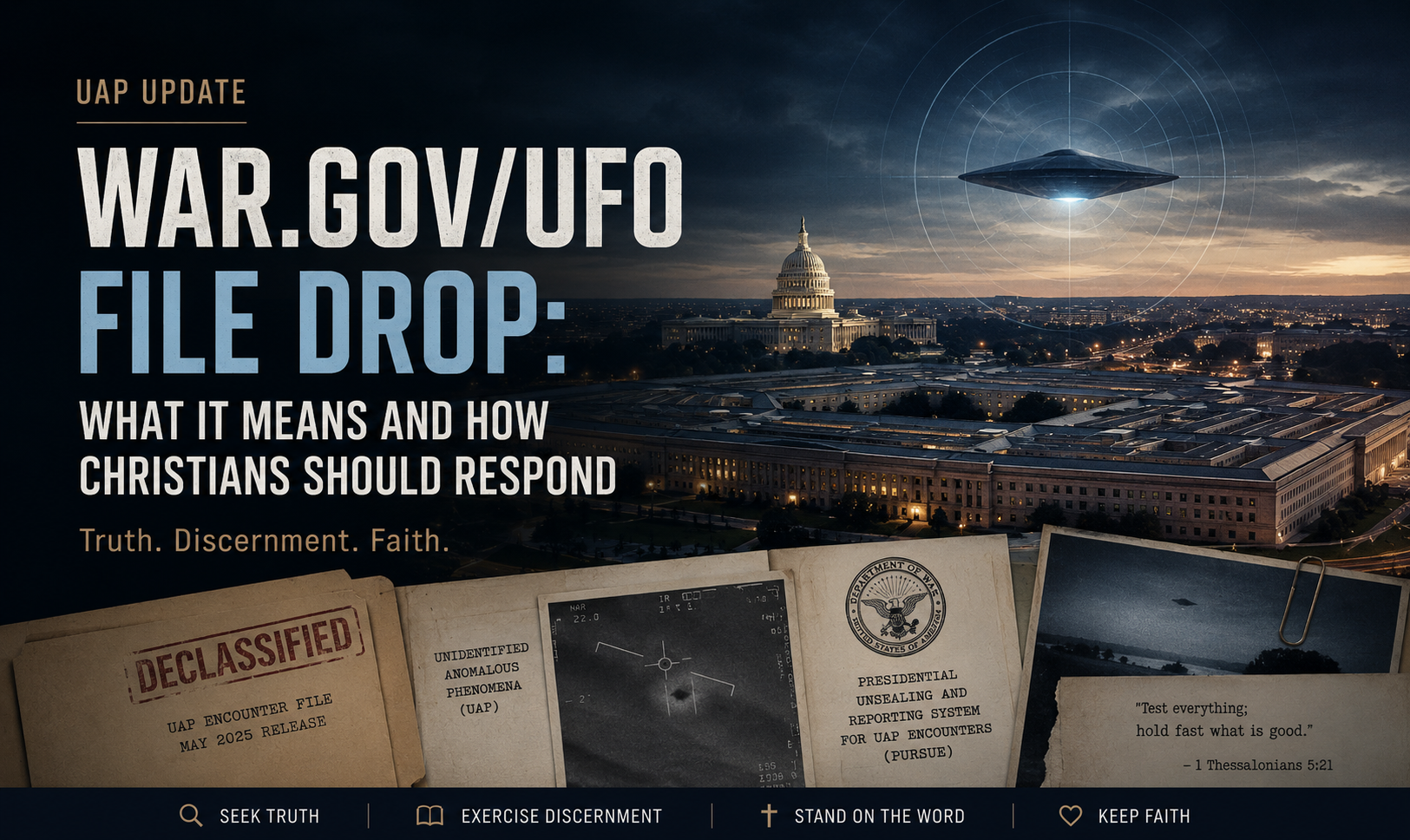
Last week, the U.S. Department of War launched a new public portal—WAR.GOV/UFO—as part of what it calls the Presidential Unsealing and Reporting System for UAP Encounters (PURSUE), publishing an initial tranche of 162 files and promising more releases “on a rolling basis.” ([U.S. Depa
As expected, the internet did what the internet does: some readers treated the release like confirmation of extraterrestrial visitation; others dismissed it as a political “shiny object.” Meanwhile, a few members of Congress welcomed the step toward transparency but emphasized that disclosure will take time. Representative **Tim Burchett**, for example, thanked the administration for “keeping his word” on transparency and cautioned that it “won’t all happen at once.”
For Christians trying to think clearly and faithfully about UAP (Unidentified Anomalous Phenomena), this moment is a good test of spiritual posture: Will we chase speculation, or practice discernment? Will we be driven by fear, or by truth and peace?**
For Christians trying to think clearly and faithfully about UAP (Unidentified Anomalous Phenomena), this moment is a good test of spiritual posture: Will we chase speculation, or practice discernment? Will we be driven by fear, or by truth and peace?**
What actually happened (and what didn’t)
The War Department’s public statement frames the release as an interagency transparency effort involving the White House, ODNI, DOE, AARO, NASA, and the FBI, among others. ([U.S. Department of War][1]) The initial files include a mix of historical records and more recent items—reports, transcripts, images, and video—some newly declassified and some resembling material already public in other forms. Reuters noted the release contains “around 160 files” and includes Apollo-era materials, but **does not provide conclusive evidence of extraterrestrial life**. ([Reuters][3]) WIRED similarly highlights that the US government has **not claimed** it has detected or encountered extraterrestrial life in these disclosures. ([WIRED][4])
That distinction matters. “Unidentified” is not the same thing as “alien.” It means unresolved given the available information—sometimes because the data are incomplete, the imagery is ambiguous, or the object is too distant or poorly captured for confident identification.
So, the file drop is significant as a transparency milestone—but it is not a theological earthquake, and it is not a proof package.
The online reaction cycle: wonder, certainty, cynicism
Within hours, the typical reaction loop kicked in:
1. Wonder: People genuinely want answers. The universe is vast; it’s natural to ask what else might be out there.
2. Certainty: Some voices quickly move from curiosity to conclusions (“This proves…”).
3. Cynicism: Others assume it’s purely political theater or a distraction.
4. Confusion: A flood of clips, screenshots, and hot takes creates the impression that “everything” is happening at once.
Even among officials and commentators, reactions diverged. Reuters captured both the pro-transparency reception—naming Burchett and Rep. Anna Paulina Luna among those welcoming the move—and the note of caution from analysts that much of what’s released can still be explained in mundane ways. ([Reuters][3]) Reporting from the Associated Press (syndicated by WABE and NBC Washington) emphasizes that experts warn UAP media is frequently misunderstood by viewers unfamiliar with military sensors and imaging artifacts. ([WABE][2])
A Christian perspective doesn’t require us to pick a team in the comment war. It asks us to do something harder: **honor truth, admit uncertainty, reject manipulation, and refuse fear.**
A Christian framework for thinking about UAP without sensationalism
Here are five grounded commitments that can guide Christians through moments like this.
1) Love truth more than “the thrill of being in the know”
Scripture is uncompromising about truthfulness. Christians should resist the temptation to elevate rumors, anonymous claims, or viral clips to the level of “revelation.” A sober approach asks: *What is actually documented? What is directly observed? What is interpretation?*
The War.gov/UFO release itself models a helpful distinction: it provides source material and acknowledges uncertainty in several cases, including captions that note there is “no consensus” about certain anomalies. ([WABE][2])
2) Practice humility about what we can infer from limited evidence
One quiet lesson from this release is how easy it is to over-read thin data. Grainy imagery, sensor quirks, and distance effects can produce compelling visuals without providing decisive identification. Even the most interesting footage often leaves room for multiple explanations.
Humility isn’t weakness; it’s intellectual honesty. It is entirely consistent to say: “This is unknown right now,” without rushing to “therefore it must be extraterrestrial.”
3) Refuse fear-based narratives
Some coverage—religious and secular—tries to monetize anxiety: *“This will shatter your worldview.”* Christians should be especially cautious here. The Christian faith does not hang on whether a government archive contains ambiguous images or unresolved reports. Our confidence rests in the character of God, not in the certainty of online theories.
If tomorrow produced credible evidence of non-human intelligence, that would raise serious questions—but it would not dethrone the Creator. Christianity already teaches that reality contains more than the material world (angels, spiritual powers, and unseen realities). But that truth is not a license to label every “unknown” as spiritual, demonic, or prophetic. Discernment means **not** treating mystery as a shortcut to certainty.
4) Support transparency without turning politics into theology
Burchett’s public posture—welcoming transparency while warning it will take time—reflects a more measured stance than many viral reactions. ([WABE][2]) Christians can affirm the public good of responsible transparency (especially when it concerns defense, air safety, or public trust) without turning the entire topic into a partisan identity marker.
Likewise, it’s fair to critique political incentives and timing. But cynicism can also become a kind of blindness—where we assume every action is manipulation, therefore no fact can ever matter. Christians should reject both naïveté and nihilism.
5) Keep wonder pointed in the right direction
The UAP conversation often reveals something deeper than curiosity about “objects in the sky.” It reveals a longing: *Are we alone? Is there meaning? Is there something bigger than our daily lives?*
Christianity has always answered: yes, reality is bigger—because God is real, creation is ordered, and human beings are made with purpose. If UAP stories stir wonder, Christians can let that wonder become worship rather than obsession.
A practical takeaway for UAPBrief readers
As The Brief continues tracking this War.gov/UFO release and future tranches, here’s a simple, repeatable approach:
* **Read the primary material first** (the actual documents, captions, and dates) before consuming commentary. ([U.S. Department of War][1])
* **Separate facts from claims**: what is documented vs what is suggested. ([Reuters][3])
* **Assume ambiguity** until evidence quality improves: one dramatic clip rarely settles anything. ([NBC4 Washington][5])
* **Reject sensational headlines** that leap from “unidentified” to “confirmed aliens.” ([Reuters][3])
* **Pray for wisdom**—for leaders, analysts, and citizens—in how truth is handled in public life.
The War.gov/UFO drop is real, and it’s newsworthy as a transparency event. But the Christian response should not be panic or prophecy-by-headline. It should be steadiness: truth-loving, humble, unafraid, and anchored.
If the next release brings genuinely stronger evidence, Christians will be able to engage it without losing their footing—because our faith was never supposed to be built on rumors, nor shaken by mysteries in the sky.
[1]: https://www.war.gov/News/Releases/Release/Article/4480582/department-of-war-releases-unidentified-anomalous-phenomena-files-in-historic-t/ "
Department of War Releases Unidentified Anomalous Phenomena Files in Historic Transparency Effort > U.S. Department of War > Release | U.S. Department of War
"
[2]: https://www.wabe.org/pentagon-begins-releasing-new-files-on-ufos-and-says-the-public-can-draw-its-own-conclusions/ "Pentagon begins releasing new files on UFOs and says the public can draw its own conclusions – WABE"
[3]: https://www.reuters.com/world/trump-releases-previously-classified-ufo-files-2026-05-08/ "Trump releases government UFO files, more expected | Reuters"
[4]: https://www.wired.com/story/pentagon-drops-new-ufo-files "The Pentagon Releases New Trove of Declassified UFO Files | WIRED"
[5]: https://www.nbcwashington.com/news/national-international/pentagon-releasing-new-files-ufos/4101937/ "UFO files shed light on sightings but leave interpretation to the public – NBC4 Washington"
UAP Brief exists to explore that mystery without fear, without hype, and without abandoning the deep foundations of faith. Truth and faith have never been enemies — and they are not now.
Where Mystery Meets Reason